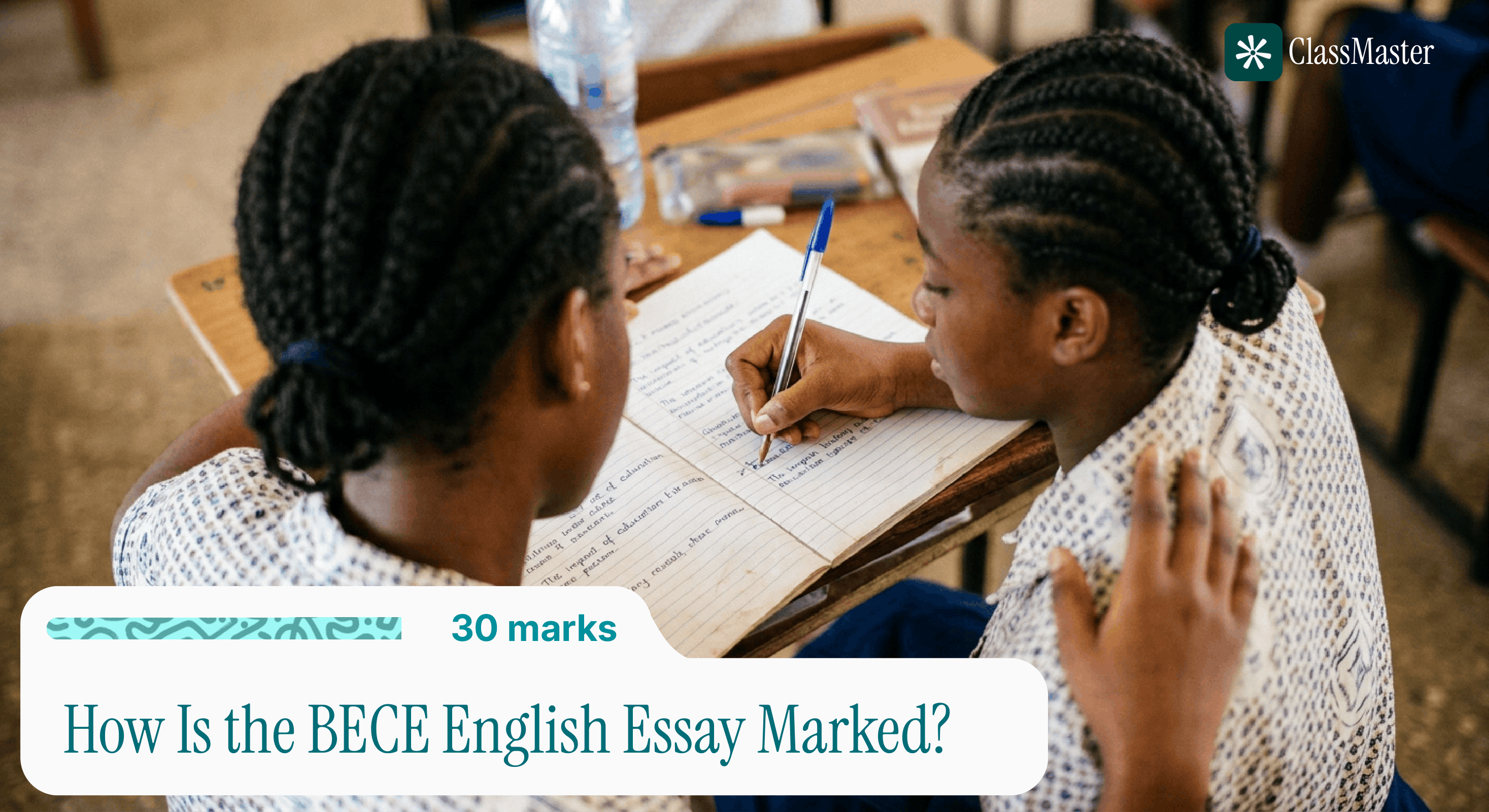
A JHS 3 student fills four pages on a composition question, hands it in, and still loses marks. The handwriting is neat. The story is long. But length is not what the BECE English marking scheme pays for, and most students never see the scheme that decides their grade. Marks leak in places nobody showed them: one developed point where the scheme expects two, an article handed in with no title, the pronoun I written as a small i, over and over. This post sets out the four criteria WAEC uses to mark the essay, what each criterion is worth out of 30, and the specific errors that cost marks under each one.
How does one good point cost half the content mark?
Content carries 10 of the 30 marks, and the fastest way to lose half of it is to make one point well instead of two. The marking scheme expects at least two well-discussed points, each supported by details. A candidate who develops a single point is typically marked out of 5 for content rather than 10. A candidate who writes on a topic completely different from the one set scores zero for content, however strong the writing is. For story questions that supply an ending statement, a narrative that does not relate to that ending statement also scores zero for content. Two points, both developed, both on the question actually asked.
What counts as correct format in BECE English essay?
Organisation is worth 5 marks and it is the criterion a student can secure before the exam starts, because most of it is format. A formal letter needs the writer's address, the date, the recipient's address, a salutation, a heading in capital letters, an introduction, a body, a conclusion, a subscription, a signature and the full name. An informal letter needs the writer's address, the date, a salutation such as Dear Kweku, a subscription such as Yours ever, and the writer's first name. An article needs a heading and the writer's name. A story needs a clear beginning, a climax and a conclusion. Write a letter when the paper asked for an article and the organisation mark is usually capped at 3 out of 5.
Slang and contracted form costs marks in formal essays
Expression carries 10 marks, the same weight as content, and it turns on register more than on vocabulary size. An article or a formal letter has to be in formal language. A letter to a friend is meant to be chatty and informal, so a student who writes to a friend in stiff formal English has missed the register. Slang, colloquialisms and contracted forms are penalised in formal essays, which means "don't" and "can't" belong in the informal letter and nowhere else on the paper. Examiners reward varied sentence patterns, appropriate vocabulary, and the effective use of idioms, proverbs and figurative language. One proverb that fits the topic does more for the expression mark than a paragraph of long words used loosely.
Half a mark comes off for every different mistake
Mechanical Accuracy is worth 5 marks and works by subtraction. Half a mark comes off for every different mistake, up to a total deduction of 5 marks, so the criterion can be wiped out completely. The errors counted include concord, meaning subject and verb agreement, wrong tenses, spelling mistakes, punctuation errors, and the wrong use of capital or small letters. Writing the first-person pronoun I as a small i is named as a specific penalised error, and it is the one a student can fix tonight. Ten different small errors cost the full 5 marks, which is the same value as the entire Organisation criterion. Five minutes spent reading back over the script is worth more than another paragraph.
Frequently asked questions
- How many words should a BECE English essay be?
- Minimum of 250 words Writing more than 250 words does not attract a deduction, but falling below 250 words can lower the mark
- Do proverbs and idioms increase marks in the BECE English essay?
- Proverbs, idioms and figurative language are rewardable features under Expression, which carries 10 marks in the BECE English essay. Examiners also reward varied sentence patterns and appropriate vocabulary. The test is effective use, so a proverb has to suit both the topic and the register of the essay.
- Does neat handwriting add marks to a BECE English essay?
- No. Handwriting is not one of the four criteria used to mark the BECE English essay. Marks come from Content, Organisation, Expression and Mechanical Accuracy. Neat handwriting helps an examiner read the script, but neat handwriting on a one-point essay still loses half the content mark.