Kwabena can recite the water cycle in his sleep. He read the Integrated Science chapter four times, copied out the diagram twice, and answered every question at the back of the textbook. Three weeks later, in the mock exam, a slightly reworded question about evaporation stares back at him and nothing comes. The page he studied so carefully has gone quiet in his head.
If you're a JHS student, or you're raising one, this scene is painfully familiar. It isn't a story about a lazy student. It's a story about a hardworking one who did everything right and still lost marks on the day it mattered.
It was never about effort
Here's what most students are never told: the brain isn't built to keep things it only meets once. Every topic starts fading almost immediately after it's learned and it usually does not mean a student is forgetful, because that is what the memory does by default. Without something bringing a fact back to mind at the right moment, it quietly slips away, even if it was understood perfectly the first time.
That second line is the whole game. It isn't about studying longer. It's about meeting the same idea again, briefly, right before it would have disappeared. A student who "just isn't good at remembering" is usually not not short on intelligence, what they might be lacking is a system that brings the right topic back at the right time, automatically, across dozens of subjects and hundreds of topics at once. No one can track that by hand.
Where ClassMaster comes in
ClassMaster is built to make the effort students put into learning count by helping them remember what they learn. was built after watching this happen to genuinely prepared students, over and over - not because they didn't know the material, but because nothing brought it back before the exam did. It's built around the actual BECE syllabus and the way core subjects are really tested, so the practice a student gets matches the exam they're walking into, not a generic quiz.
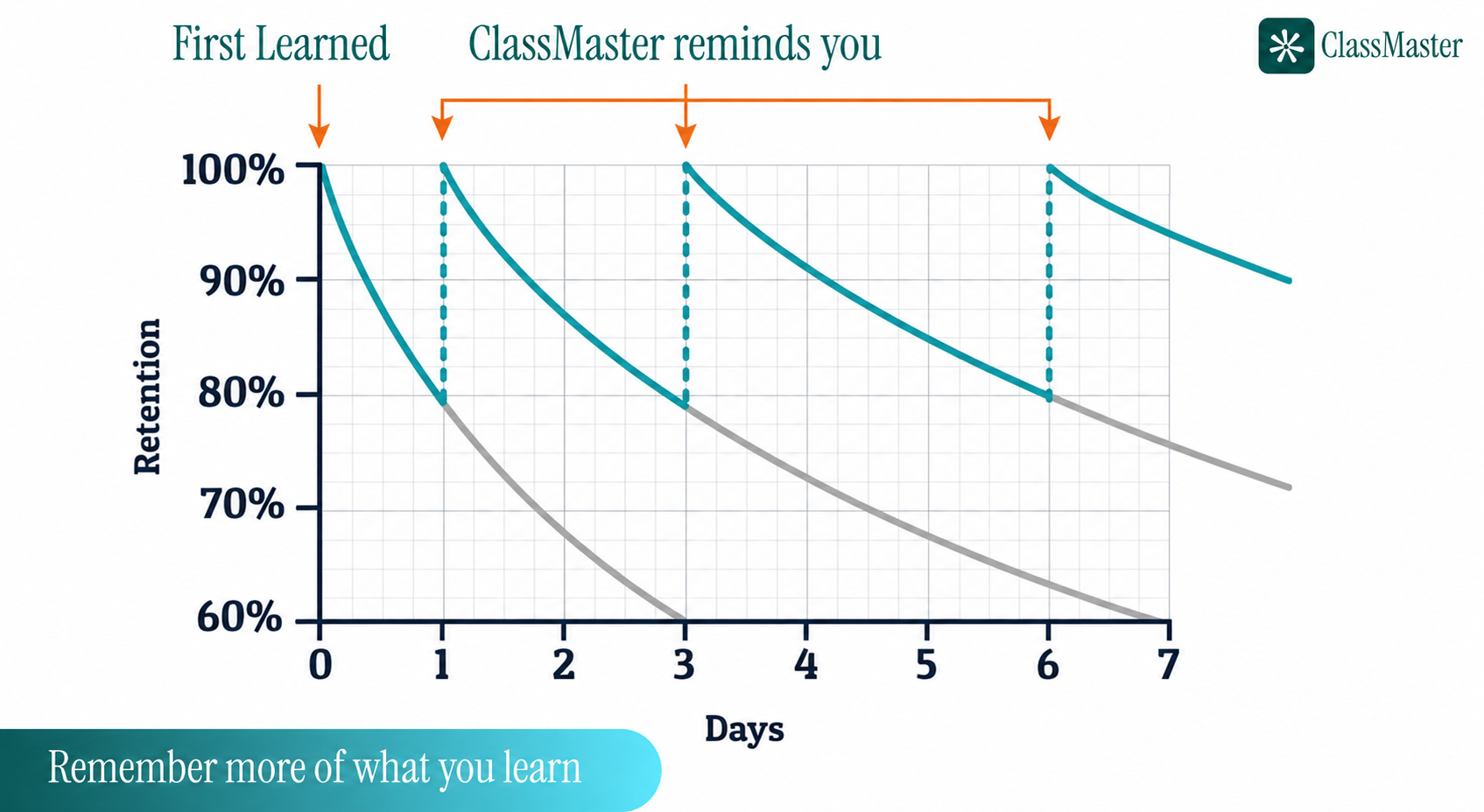
More importantly, ClassMaster does the one thing a printed notebook can't: it quietly keeps track of what a student learned and when, and resurfaces the topics that are starting to fade - before they're gone, not after.
How it works, step by step
The idea is simple. First, a student learns a topic - say, chemical changes in Integrated Science - through clear explanations built for how it's actually examined in BECE. Second, ClassMaster quietly brings that topic back in short bursts of practice over the following days and weeks, right around when it would otherwise start slipping. Third, a simple dashboard shows exactly which topics are solid and which still need another pass, so revision time goes where it's actually needed instead of being spent re-reading what's already known.
What's actually at stake
This isn't a small thing. The gap between a student who understood the material and a student who scores well on it is, more often than not, exactly this: whether the right topic came back to mind on the right day.
Without a system like this, students face the night-before panic. Formulas that were solid in class going blurry in the exam hall, marks lost not from a lack of understanding but from a memory that simply wasn't reminded in time. With ClassMaster, a student walks into the BECE having already met every topic several times, at the moments that mattered most, so what was studied months ago is still there when it's needed.
Kwabena didn't need to study harder. He needed his revision to remember him back and to know which topic was fading and put it back in front of him before exam day did it for free.
Frequently asked questions
- Why do students forget what they studied even after reading it several times?
- Reading a topic once creates a memory that fades quickly by default - a normal feature of how the brain works, not a sign of poor intelligence. Without a short practice session that brings the topic back to mind before it fully fades, most of what was read is lost within weeks, no matter how many times it was re-read in a single sitting.
- What is spaced repetition and how does ClassMaster use it?
- Spaced repetition is a study method that revisits a topic in short sessions spread over increasing intervals, rather than in one long session. ClassMaster applies this automatically across every subject a JHS student is studying, quietly resurfacing each topic for quick practice right before it would naturally start to fade.
- Does ClassMaster replace normal classroom revision?
- No. ClassMaster is built to work alongside normal classroom teaching and revision, not replace it. Its role is making sure what a student already learned in class stays retrievable by exam day, by bringing topics back for short practice at the right intervals.
- How does a parent know if a topic is being forgotten?
- ClassMaster's dashboard shows which topics a student has practiced recently and which are starting to fade, giving both the student and their parent a clear view of where revision time is actually needed before the BECE.